

Hardware Specifications |
|
|---|---|
| 802.11n | Four spatial streams |
| · Radio 1 – 2.4 GHz: 2×2 MIMO, two spatial streams | |
| · Radio 2 – 5 GHz: 2×2 MIMO, two spatial streams | |
| Channels: | |
| · Radio 1 – 2.4 GHz: 20 MHz and 40 MHz | |
| · Radio 2 – 5 GHz: 20 MHz and 40 MHz | |
| Combined peak data rate: 600 Mbps | |
| · Radio 1 – 2.4 GHz: 6.5 Mbps to 300 Mbps (MCS0 to MCS15 ) | |
| · Radio 2 – 5 GHz: 6.5 Mbps to 300 Mbps (MCS0 to MCS31) | |
| Radio technologies: Orthogonal Frequency-Division Multiplexing (OFDM) | |
| Modulation types: BPSK, QPSK, 16-QAM, 64-QAM | |
| Packet aggregation: | |
| · Aggregate MAC Protocol Data Unit (A-MPDU) | |
| · Aggregate MAC Service Data Unit (A-MSDU) | |
| Dynamic Frequency Selection (DFS) | |
| Cyclic Delay/Shift Diversity (CDD/CSD) | |
| Maximum Ratio Combining (MRC) | |
| Space-Time Block Coding (STBC) | |
| Low-Density Parity Check (LDPC) | |
| Transmit beam-forming (TxBF) | |
| 802.11ac | Two spatial streams |
| · Radio 2 – 5 GHz: 2×2 MIMO, two spatial streams | |
| Channels: | |
| · Radio 2 – 5 GHz: 20 MHz, 40 MHz, 80 MHz, and 160 MHz | |
| Combined peak data rate: 1.733 Gbps | |
| · Radio 2 – 5 GHz: 6.5 Mbps to 1.733 Gbps (MCS0 to MCS9) | |
| Radio technologies: Orthogonal Frequency-Division Multiplexing (OFDM) | |
| Modulation types: BPSK, QPSK, 16-QAM, 64-QAM, 256-QAM | |
| Packet aggregation: | |
| · Aggregate MAC Protocol Data Unit (A-MPDU) | |
| · Aggregate MAC Service Data Unit (A-MSDU) | |
| Dynamic Frequency Selection (DFS) | |
| Cyclic Delay/Shift Diversity (CDD/CSD) | |
| Maximum Ratio Combining (MRC) | |
| Space-Time Block Coding (STBC) | |
| Low-Density Parity Check (LDPC) | |
| Transmit beam-forming (TxBF) | |
| 802.11ax | Four spatial streams |
| · Radio 1 – 2.4 GHz: 2×2 uplink/downlink MU-MIMO, two spatial streams | |
| · Radio 2 – 5 GHz: 2×2 uplink/downlink MU-MIMO, two spatial streams | |
| Channels: | |
| · Radio 1 – 2.4 GHz: 20 MHz and 40 MHz | |
| · Radio 2 – 5 GHz: 20 MHz, 40 MHz, 80 MHz, and 160 MHz | |
| Combined peak data rate: 2.976 Gbps: | |
| · Radio 1 – 2.4 GHz: 8.6 Mbps to 0.574 Gbps (MCS0 to MCS11) | |
| · Radio 2 – 5 GHz: 8.6 Mbps to 2.402 Gbps (MCS0 to MCS11) | |
| Radio technologies: uplink/downlink Orthogonal Frequency-Division Multiple Access (OFDMA) | |
| Modulation types: BPSK, QPSK, 16-QAM, 64-QAM, 256-QAM, 1024-QAM | |
| Packet aggregation: | |
| · Aggregate MAC Protocol Data Unit (A-MPDU) | |
| · Aggregate MAC Service Data Unit (A-MSDU) | |
| Dynamic Frequency Selection (DFS) | |
| Cyclic Delay/Shift Diversity (CDD/CSD) | |
| Maximum Ratio Combining (MRC) | |
| Space-Time Block Coding (STBC) | |
| Low-Density Parity Check (LDPC) | |
| Transmit beam-forming (TxBF) | |
| WPA3 | |
| Antenna | Wi-Fi |
| · 2.4 GHz: two built-in omnidirectional smart antennas, the max. antenna gain is 3 dBi. | |
| · 5 GHz: two built-in omnidirectional smart antennas, the max. antenna gain is 3 dBi. | |
| Bluetooth | |
| · One onboard omnidirectional antenna, the max. antenna gain is 2.4 dBi. | |
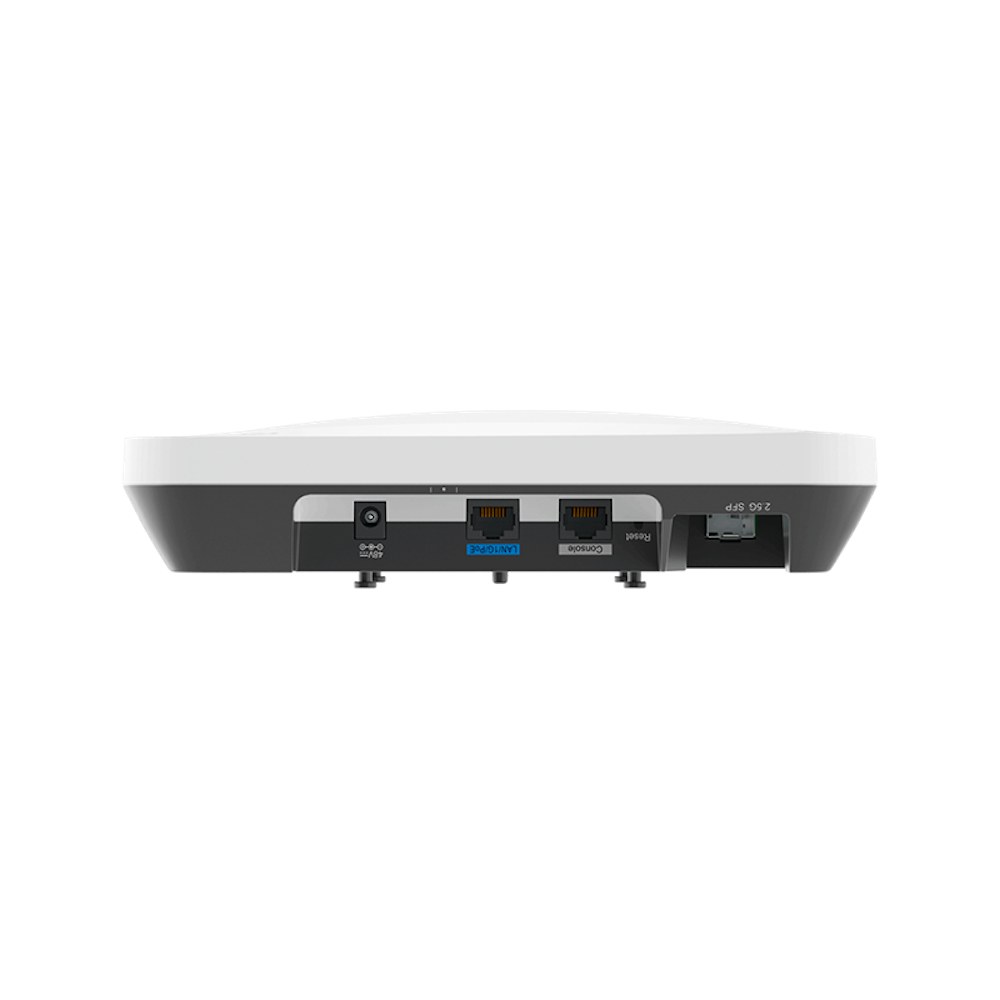
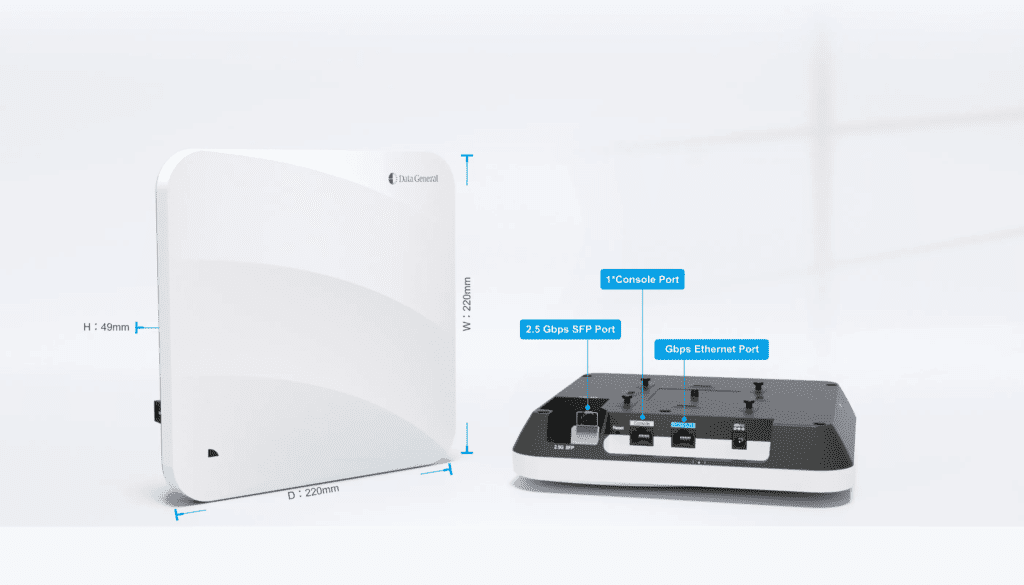
| Port | 1 x 10/100/1000Base-T RJ45 Ethernet port with auto-negotiation |
| 1 x 2.5GE combo SFP port (10/100/1000Base-T electrical port), conformity to 1GE SFP | |
| 1 x RJ45 console port (serial console port) | |
| 1 x Bluetooth 5.1 | |
| Status LED | 1 x multi-color system status LED |
| · AP power-on status | |
| · Software initialization status and upgrade status | |
| · Uplink service interface status | |
| · Wireless user online status | |
| · CAPWAP tunnel timeout | |
| · Specific AP locating | |
| Button | 1 x Reset button |
| · Press the button for shorter than 2 seconds. Then the device restarts. | |
| · Press the button for longer than 5 seconds. Then the device restores to factory settings. | |
| Dimensions (W x D x H) | Main unit: 220 mm x 220 mm x 49 mm (8.66 in. x 8.66 in x 1.93 in.) |
| Shipping: 507 mm x 319 mm x 278 mm (19.96 in. x 12.56 in. x 10.94 in.) | |
| Weight | Main unit: 0.6 kg (1.33 lbs) |
| Mounting bracket: 0.2 kg (0.44 lbs) | |
| Shipping: 1.04 kg (2.29 lbs) | |
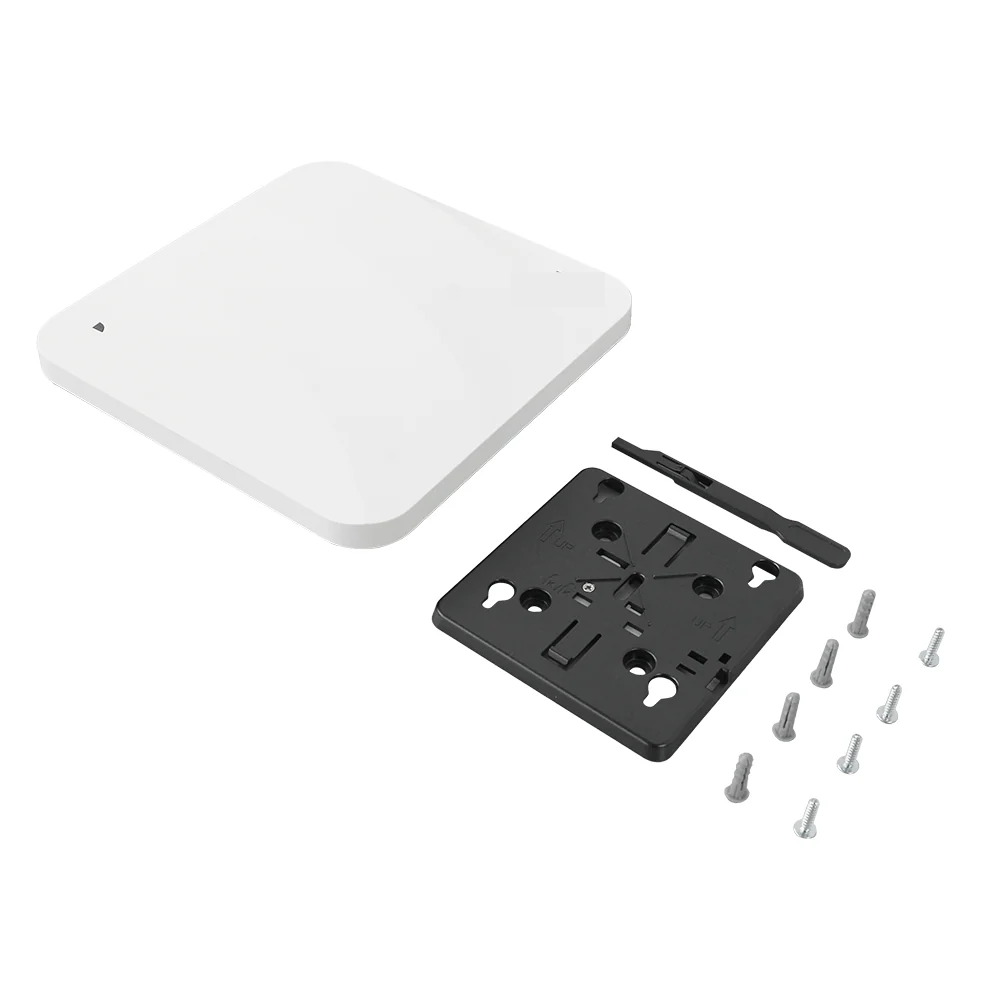
| Mounting | Wall/Ceiling-mount (a mounting bracket is delivered with the main unit) |
| Lock option | Kensington lock and securing latch |
| Input power supply | The AP supports the following two power supply modes: |
| · 48 V/0.6 A power input over DC connector: The DC connector accepts 2.1 mm/5.5 mm center-positive circular plug. A DC power supply needs to be purchased independently. | |
| · PoE input over LAN 1: The power source equipment (PSE) complies with IEEE 802.3af standard (PoE). | |
| Note: If both DC power and PoE are available, DC power is preferred. | |
| Power consumption | Maximum power consumption: 12.95 W |
| · DC power: 12.95 W | |
| · 802.3bt (PoE++): 12.95 W | |
| · 802.3at (PoE+): 12.95 W | |
| · 802.3af (PoE): 12.95 W | |
| · Idle mode: 6 W | |
| Environment | Storage temperature: –40°C to +70°C (–40°F to +158°F) |
| Storage humidity: 0% RH to 95% RH (non-condensing) | |
| Operating temperature: –10°C to +50°C (14°F to 122°F) | |
| Operating humidity: 0% RH to 95% RH (non-condensing) | |
| At an altitude between 3,000 m (9,842.52 ft.) and 5,000 m (16,404.20 ft.), every time the altitude increases by 166 m (546.81 ft.), the maximum temperature decreases by 1°C (1.8°F). | |
| Mean Time Between Failure (MTBF) | 200,000 hours (22 years) at the operating temperature of 25°C (77°F) |
| System memory | 512 MB DRAM, 128 MB flash |
| Max. transmit power | 2.4 GHz: 26 dBm (398 mW) |
| 5 GHz: 26 dBm (398 mW) | |
| Note: | |
| · Adjusting the transmit power by percentage (recommended) and in 1dBm increments | |
| · The transmit power is limited by local regulatory requirements. | |
Software Specifications |
|
Basic Function |
|
| Applicable software version | RGOS11.9(6)W1B4 or later |
WLAN |
|
| Max. number of associated STAs | 256 (up to 128 STAs per radio) |
| Max. number of BSSIDs | 32 (up to 16 BSSIDs per radio) |
| WLAN service | Max. number of WLAN IDs: 16 |
| Max. number of associated STAs per WLAN: 32 | |
| STA management | SSID hiding |
| Each SSID can be configured with the authentication mode, encryption mechanism, and VLAN attributes independently. | |
| Remote Intelligent Perception Technology (RIPT) | |
| Intelligent STA identification technology | |
| Intelligent load balancing based on the STA quantity or traffic | |
| STA limiting | SSID-based STA limiting |
| Radio-based STA limiting | |
| Bandwidth limiting | STA/SSID/AP-based rate limiting |
| CAPWAP | IPv4/IPv6 CAPWAP |
| CAPWAP through NAT | |
| Encryption over CAPWAP data channels | |
| Encryption over CAPWAP control channels | |
| Data forwarding | Centralized and local forwarding |
| Wireless roaming | Layer 2 and Layer 3 roaming |
| Wireless locating | MU device locating |
Security and Authentication |
|
| Authentication and encryption | Remote Authentication Dial-In User Service (RADIUS) |
| PSK ,PPSK, UPSK, PEAP and web authentication | |
| QR code-based guest authentication, SMS authentication, and MAC address bypass (MAB) authentication (used with RG-WS series ACs) | |
| Data encryption: WEP (64/128 bits), WPA-TKIP, WPA-PSK, WPA2-AES | |
| Data frame filtering | Allowlist, static blocklist, and dynamic blocklist |
| WIDS | Wireless Intrusion Detection System(WIDS) |
| User isolation | |
| Rogue AP detection and containment | |
| ACL | IP standard ACL, MAC extended ACL, IP extended ACL, and expert-level ACL |
| IPv6 ACL | |
| Time range-based ACL | |
| ACL based on a Layer 2 interface | |
| ACL based on a Layer 3 interface | |
| Ingress ACL based on a wireless interface | |
| ACL Remark | |
| Dynamic ACL assignment based on 802.1X authentication (used with the AC) | |
| CPP | CPU Protect Policy (CPP) |
| NFPP | Network Foundation Protection Policy (NFPP) |
Routing and Switching |
|
| MAC | Static and filtered MAC addresses |
| MAC address table size: 1,024 | |
| Max. number of static MAC addresses: 1,024 | |
| Max. number of filtered MAC addresses: 1,024 | |
| Ethernet | Jumbo frame length: 1,518 |
| Ethernet II frame format | |
| 1000M SFP ports | |
| 2.5GE interfaces | |
| VLAN | Interface-based VLAN assignment |
| Max. number of SVIs (IPv4): 200 | |
| Max. number of SVIs (IPv6): 200 | |
| Max. number of VLANs: 4,094 | |
| VLAN ID range: 1–4,094 | |
| ARP | ARP entry aging, gratuitous ARP learning, and proxy ARP |
| Max. number of ARP entries: 1,024 | |
| ARP check | |
| IPv4 services | Static and DHCP-assigned IPv4 addresses |
| Max. number of IPv4 addresses configured on each Layer 3 interface: 200 | |
| NAT, FTP ALG and DNS ALG | |
| IPv6 services | IPv6 addressing, Neighbor Discovery (ND), ICMPv6, IPv6 ping, IPv6 tracert |
| IPv6 DHCP client | |
| Max. number of IPv6 addresses configured on each Layer 3 interface: 400 | |
| Max. number of ND entries: 4,096 | |
| IP routing | IPv4/IPv6 static route |
| Max. number of static IPv4 routes: 1,024 | |
| Max. number of static IPv6 routes: 1,000 | |
| Multicast | Multicast-to-unicast conversion |
| VPN | PPPoE client |
| IPsec VPN | |
Network Management and Monitoring |
|
| Network management | Fault detection and alarm |
| Information statistics and logging | |
| Network management platform | Web management (Eweb) |
| RG-WS series wireless controller and Ruijie Cloud | |
| User access management | Console, Telnet, SSH, FTP client, FTP server, and TFTP client |
| Switchover among Fat, Fit, and cloud modes | When the AP works in Fit mode, it can be switched to Fat mode through an AC. |
| When the AP works in Fat mode, it can be switched to Fit mode through the console port or Telnet mode. | |
| When the AP works in cloud mode, it can be managed through Ruijie Cloud. | |
| Value-added Software | |
| The following value-added software functions can be achieved with the WIS solution (used with RG-iData-WIS and wireless controller). | |
Value-added Software |
|
Intelligent O&M |
|
| Experience | Network operation analysis, such as device stability and signal coverage |
| Measuring users’ network experience based on indicators such as the latency, packet loss, signal strength, and channel utilization, and visualizing results of the network experience | |
| Statistics on the number of online and offline failures of STAs associated with different APs, average signal strength, and other parameters | |
| VIP monitoring and alarm, and custom alarm thresholds | |
| STA global experience map and experience coverage evaluation based on the time range | |
| STA access protocol replay and fine-grained STA fault diagnosis | |
| Note: To support the preceding functions, ensure that the AP works in Fit mode. | |
| Network optimization | Network performance optimization, including one-click network optimization and scenario-based optimization |
| Client steering to co
FIRMWARE DGOS11.9(6)W2B1S5_S2X4-04_10201818
DATASHEETS   |