Network accessories: everything you need for a professional installation
Network accessories are the components that make a clean and durable installation possible. A low-quality cable or the absence of the right tools can compromise the performance of the entire infrastructure. The Data General accessories catalogue is designed to complement WiFi packs and Air range equipment at every phase of the installation.
PoE injectors: power without a PoE switch
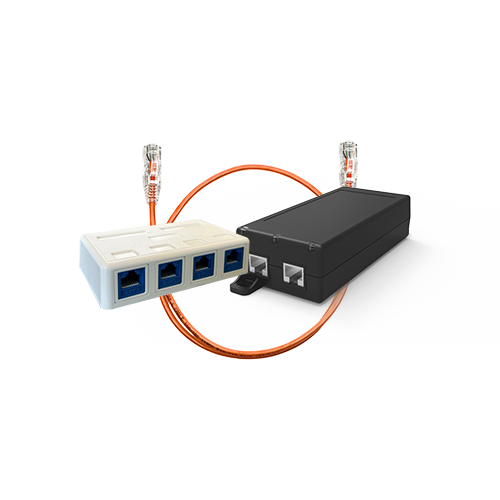
When a PoE switch is not available or a single device needs to be powered in isolation, a PoE injector is the simplest solution: it takes power from a standard mains socket and injects it into the Ethernet cable, with no additional electrical cabling required.
Data General offers two standards. The PoE+ injector (IEEE 802.3at) supplies up to 30W at Gigabit speed, suitable for the vast majority of WiFi 6 APs and IP cameras. The PoE++ injector (IEEE 802.3bt) reaches 90W at 5 Gbps, required for high-performance WiFi 6E APs, digital signage and devices demanding greater power.
Cat6 Ultra-Slim cables: clean installation in any space
Cat6 UTP Ultra-Slim patch cords are designed for installations where space is limited or aesthetics matter. Their reduced diameter makes them ideal for routing through trunking, door frames and narrow gaps where a standard cable is too visible.
The catalogue includes lengths of 50 cm, 1 m, 2 m, 5 m, 10 m and 20 m. These are the cables included in Signal packs, where the 5 m and 20 m lengths cover the typical distance between the controller and APs in home and office installations. The transparent DG-INS-FIX50 wall clip strips allow cable runs to be fixed to the wall discreetly, with 50 units per pack.
Structured cabling and tools
For installations requiring professional cable termination, Data General offers the DG-CAT6-KS RJ45 keystone connector, DG-BOX-2KS and DG-BOX-4KS wall boxes for 2 or 4 keystones, and the DG-INS-PT punch-down tool for correct conductor termination.
The DG-INS-TST cable tester verifies the continuity and termination of any UTP or FTP cable before the installation is signed off. It checks all 8 conductors simultaneously and identifies crossed cables, reversed pairs or breaks — preventing connectivity issues that would be difficult to diagnose once cabling is concealed.